
Photo by CDC/Dr. Lucille K. Georg Creation, See commons.wikimedia.org

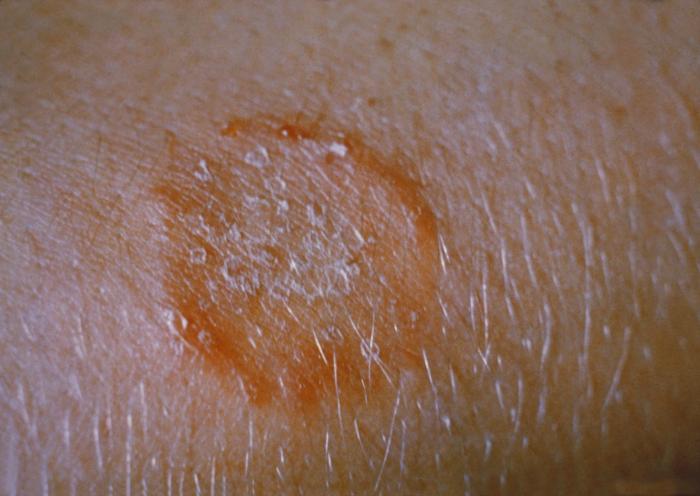
Fungal infections, commonly known as ringworm, are skin conditions caused by various fungi, often leading to intensely itchy rashes in patients. Fungi thrive in the keratin-rich environment of the skin’s epidermal layer, which provides ideal nutrients for their growth. Depending on the infection site and fungal species, ringworm can manifest in various forms, requiring different treatment approaches. Topical antifungal creams and oral medications are the most commonly used treatments for ringworm.
Tinea corporis is one of the most common fungal infections, typically appearing on the trunk and limbs. Common symptoms include ring-shaped rashes with distinct edges, mild vesicles, and scaling, with the center of the lesion often appearing clearer. These annular rashes may gradually expand outward and cause severe itching, significantly impacting patients’ quality of life. Another prevalent form is tinea pedis, commonly known as athlete’s foot, which primarily affects the feet, especially between the toes, causing intense itching, skin flaking, and even fissures. Tinea cruris, affecting the groin area, often presents with erythema and swelling, sometimes spreading to the inner thighs.
Another type of fungal infection is onychomycosis, a chronic and stubborn nail infection. Onychomycosis typically manifests as thickened nails with yellowish-white or brownish discoloration, structural irregularities, or even nail detachment. Due to the slow growth rate of nails, treatment is challenging. Recent studies have explored laser therapy, which uses concentrated thermal energy to destroy fungal cells within the nail, achieving a fungicidal effect, though recurrence rates remain relatively high.
Fungal infections are primarily transmitted through direct skin contact or indirectly via contaminated objects such as shared towels, bath mats, gym equipment, or floors. Fungal spores can survive in the environment, and contact with spore-contaminated items can lead to their establishment and proliferation in the skin’s keratin layer. Therefore, maintaining good personal hygiene, avoiding sharing personal items, and keeping the skin dry are crucial preventive measures against fungal infections.
In the early stages of ringworm, patients may experience mild itching and localized scaling. As the condition progresses, the rash typically forms a distinct annular edge and spreads outward. Due to the visual similarity between ringworm and eczema, some patients may mistakenly assume they have eczema and self-treat with steroid-containing creams. Such misuse is not only ineffective but may further suppress local immune responses, worsening the fungal infection. Accurate diagnosis is critical, and patients are advised to consult a dermatologist if symptoms persist or are unclear to avoid delayed treatment.
For treating fungal infections, mild cases can often be managed with topical antifungal creams containing active ingredients such as '克霉唑' (Clotrimazole), '特比萘芬' (Terbinafine), or '酮康唑' (Ketoconazole). These creams directly kill or inhibit fungal growth on the skin surface and within the keratin layer. In more severe or widespread infections, oral antifungal medications like '伊曲康唑' (Itraconazole), '灰黃黴素' (Griseofulvin), or '特比萘芬' (Terbinafine) are more appropriate. Oral treatments typically require longer courses, with regular monitoring of liver function and other indicators to ensure safe use.
For stubborn fungal infections like onychomycosis, laser therapy may be used alongside traditional medications. Laser treatment employs high-energy thermal effects to directly destroy fungal cells in the nail or skin lesions, delivering localized heat to achieve a fungicidal effect. Although laser technology has advanced rapidly, its high cost and variable efficacy across individuals mean it is currently primarily an adjunctive treatment.
In daily life, good personal hygiene is essential for preventing fungal infections. Patients should regularly clean and disinfect commonly used items, especially in public places like gyms or swimming pools, where keeping feet and body dry is particularly important. Thoroughly drying the body, especially between the toes, after bathing can effectively reduce fungal spore proliferation. Additionally, avoiding tight or non-breathable clothing helps prevent fungal growth in warm, moist environments.
In summary, ringworm and other fungal infections are common and contagious skin conditions, typically presenting as annular rashes, itching, and scaling. Accurate diagnosis and scientific treatment—including topical antifungal creams, oral antifungal medications, and, when necessary, laser therapy—can effectively control and cure these infections. Good personal hygiene is also a critical component of prevention. Through comprehensive treatment and preventive measures, most patients can restore healthy skin and minimize the risk of fungal infection recurrence.
References:
1. Gupta, A. K., & Cooper, E. A. (2008). Update in antifungal therapy of dermatophytosis. Mycopathologia, 165(2), 53-60.
2. Havlickova, B., Czaika, V. A., & Friedrich, M. (2008). Epidemiological trends in skin mycoses worldwide. Mycoses, 51(s4), 2-15.
3. Elewski, B. E. (1998). Onychomycosis: pathogenesis, diagnosis, and management. Clinical Microbiology Reviews, 11(3), 415-429.
4. Carruthers, A. (2005). Laser and light-based treatments of onychomycosis and other fungal infections. Journal of Cosmetic and Laser Therapy, 7(4), 203-208.